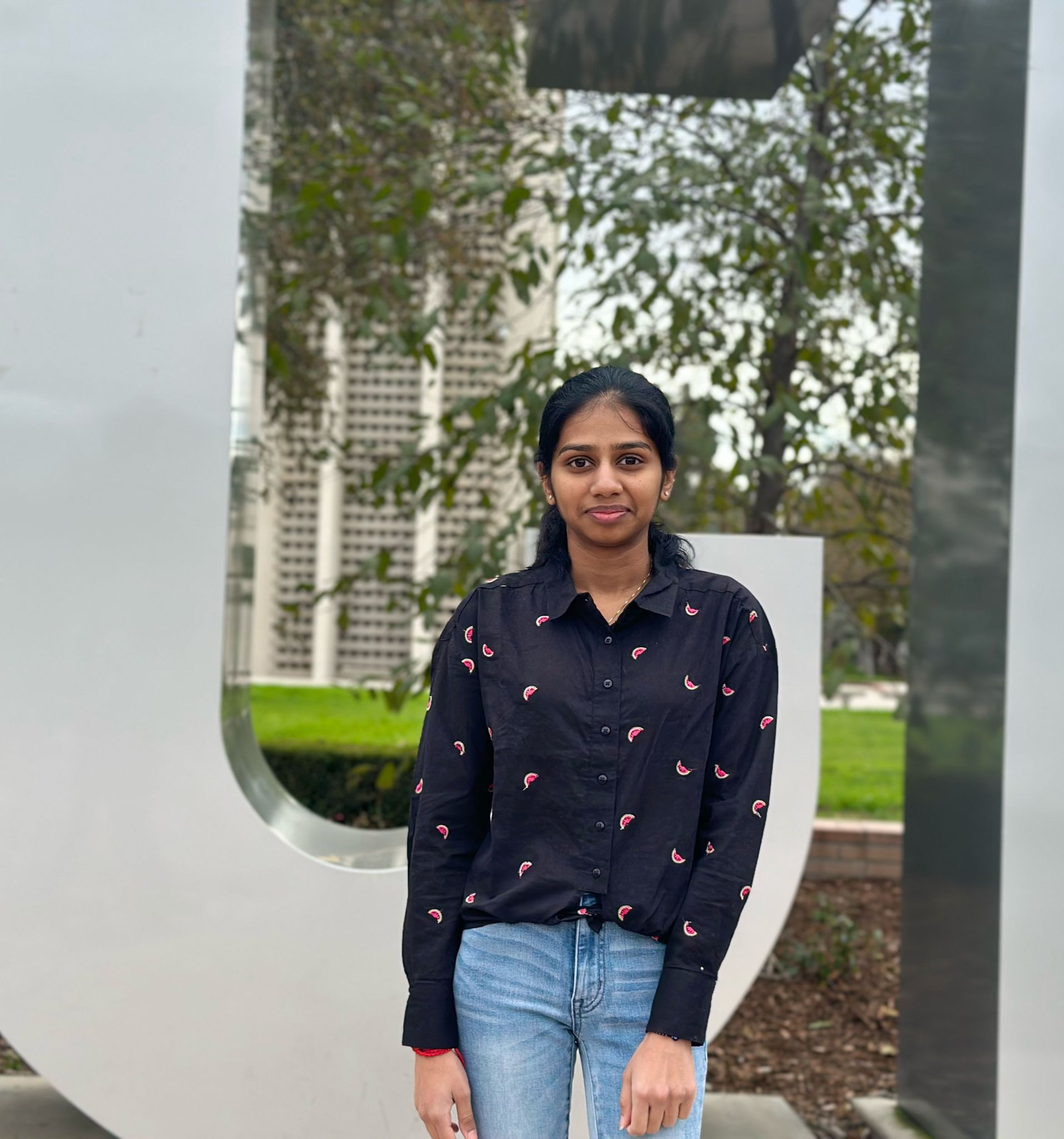
Abinila Siva AI Engineer

Avatar

Welcome to My Professional Space

I'm an AI/ML Engineer with a Master of Science in Computer Science from University of California, Riverside. Specializing in Artificial Intelligence, Machine Learning, Computer Vision, and Generative AI, I have honed my skills in deep learning and cutting-edge technologies to create innovative solutions with significant impact.

Professional Odyssey and Expertise:

My career began at Multicoreware Inc, where I navigated the complexities of AI, from optimizing deep learning algorithms for efficiency and effectiveness to deploying advanced models on embedded platforms. My work has significantly contributed to autonomous vehicle technologies, highlighting my expertise in AI quantization, GPU acceleration, and cloud technologies. These experiences have honed my skills in Python, C++, TensorFlow, PyTorch, and cloud services like AWS, alongside DevOps tools such as Docker and Kubernetes.

Looking Forward:

As I carve my path forward, I am passionate about leveraging my comprehensive engineering background and expertise in AI for developing innovative solutions. Eager for challenges that expand the horizons of AI/ML and Computer Vision, I aim to contribute to transformative projects with meaningful societal and industry impact.

Interested in working together or having a chat? Feel free to drop me a line on email or LinkedIn.


Work Experience

MCW

Software Engineer Intern - Multicoreware Inc, San Jose.
June 2023 - Dec 2023

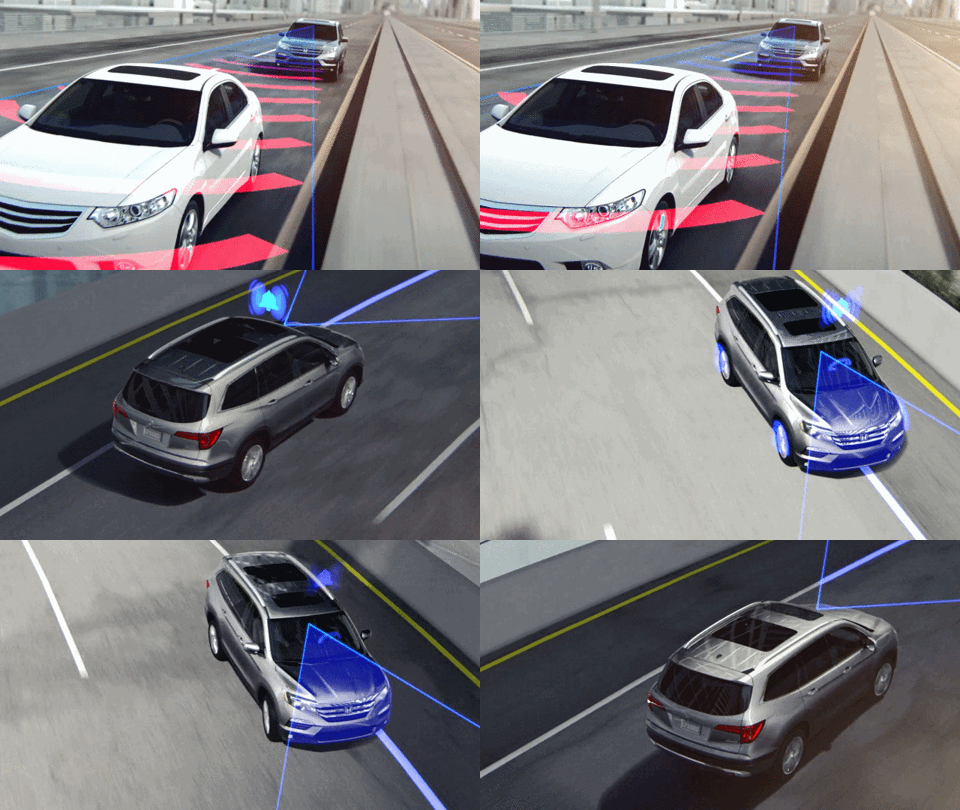
At the cutting edge of autonomous vehicle technology, I embarked on an exhilarating journey with Multicoreware. I led a comparative study on 3D object detection algorithms like VoxelNet, PointPillar, and Center-Point, utilizing Camera-Lidar fusion and Amazon SageMaker. My major contribution was developing a hybrid AI system for autonomous trucking, improving lane marking and center estimation accuracy with DNN and geometric techniques.

Additionally, I participated in the ICCV 2023 RCV Workshop's Kaggle competition, securing 4th place by crafting an efficient model for the UltraMNIST dataset (predict the sum of 3-5 digits per image), showcasing optimal performance under tight GPU constraints.

Technologies Used:

  • 3D Object Detection Algorithms: VoxelNet, PointPillar, Center-Point
  • Camera-Lidar and Camera-Sensor Fusion Techniques
  • Amazon SageMaker for Model Development and Training
  • Deep Neural Networks (DNN)
  • Geometric Techniques for Lane Marking and Center Estimation
  • NVIDIA V100 GPU for Model Training and Inference
MCW

Software Engineer - Multicoreware Inc, Chennai, India.
Dec 2020 - June 2022

My professional journey began with a deep dive into AI model optimization, leading to the enhancement of over 20 algorithms across various model types, including Image Classification, Object Detection, Semantic Segmentation, and Transformer models. Utilizing Qualcomm's AIMET SDK, I managed to significantly refine model precision with less than a 2% loss in accuracy during INT8 quantization, laying the groundwork for efficient 8-bit acceleration and edge deployment. The successful deployment of quantized ONNX models on Nvidia-Jetson Xavier and Qualcomm (QNNDrive) hardware, through meticulous benchmarking and performance evaluations via ONNX Runtime and TensorRT, resulted in up to a 25% boost in model accuracy and integrity, marking a leap towards excellence.

Beyond technical milestones, my efforts significantly bolstered the safety and precision of ADAS applications, meriting the "Spot Award" in 2021-2022 for exceptional contributions to advancing autonomous driving technology. By integrating Docker, CI/CD pipelines, Atlassian Bitbucket, and Jira tickets, we achieved streamlined project management and enhanced team collaboration, further enriching my expertise in Git and solidifying my role in pioneering AI and autonomous system advancements.

This tenure was more than just a job; it embodied a passionate commitment to innovation and pushing the technological envelope. My time at Multicoreware has been transformative, equipping me with a profound base for my professional growth and setting a solid foundation for future endeavors in the dynamic field of AI and autonomous systems.

Technologies Used:

  • C++, Python, PyTorch, TensorFlow
  • GPU Parallelism, ONNX
  • Qualcomm's AIMET SDK, Nvidia-Jetson Xavier, Qualcomm (QNNDrive)
  • Docker for containerization
  • CI/CD Pipelines for streamlined development and deployment
  • Atlassian Bitbucket for source code management
  • Jira for project and issue tracking
  • Git for version control and collaboration

Personal Projects

AI-Driven Financial Analysis Chatbot

AI-Driven Financial Analysis Chatbot

Project Overview:

Engineered an advanced AI-driven chatbot for real-time financial market analysis, leveraging two cutting-edge models: GPT-3.5 integrated with Yahoo Finance API for data-driven insights, and LLaMA-2 combined with Retrieval-Augmented Generation (RAG) for dynamic finance-related Q&A. The project features web scraping with BeautifulSoup and Selenium, offering users accurate market outlooks through a user-friendly GUI on Streamlit for one version, and a sophisticated Q&A interface in the other.

Key Features:

  • Dual-Model Integration: Offers two versions employing GPT-3.5 and LLaMA-2 models for diverse user queries.
  • Real-Time Data Acquisition: Utilized BeautifulSoup and Selenium for efficient web scraping, ensuring access to the latest financial information.
  • User-Friendly Interface: Streamlit-based interface enhances user experience with easy navigation and interaction.

Technologies Used:

Python, BeautifulSoup, Selenium, GPT-3.5, LLaMA-2, RAG, Yahoo Finance API, Streamlit.

Source

2D Object Detection on RADAR Dataset Visualization

2D Object Detection on RADAR Dataset in Adverse Weather

Enhancing autonomous vehicle navigation, this initiative implemented Faster R-CNN with ResNet 101 for 2D radar-based object detection under challenging weather. Using the RADIATE dataset, it showcased a significant improvement in detection precision, reinforcing radar's advantage over cameras in poor visibility conditions.

Technical Highlights:

  • Faster R-CNN and ResNet 101: Utilized for robust 2D object detection, highlighting the effectiveness of radar over camera sensors in adverse conditions.
  • RADIATE Dataset: Empowered the research with extensive radar sensor data, facilitating a comprehensive analysis of object detection performance in various weather scenarios.
  • Precision Improvement: Achieved a 35% increase in object detection precision, setting new benchmarks for accuracy in autonomous vehicle sensing technologies.

Technologies Used:

Faster R-CNN, ResNet 101, RADIATE dataset, Radar Sensor Technology, Python.

Emotion Detection from Tom and Jerry videos gif

Emotion Detection from Tom and Jerry Videos

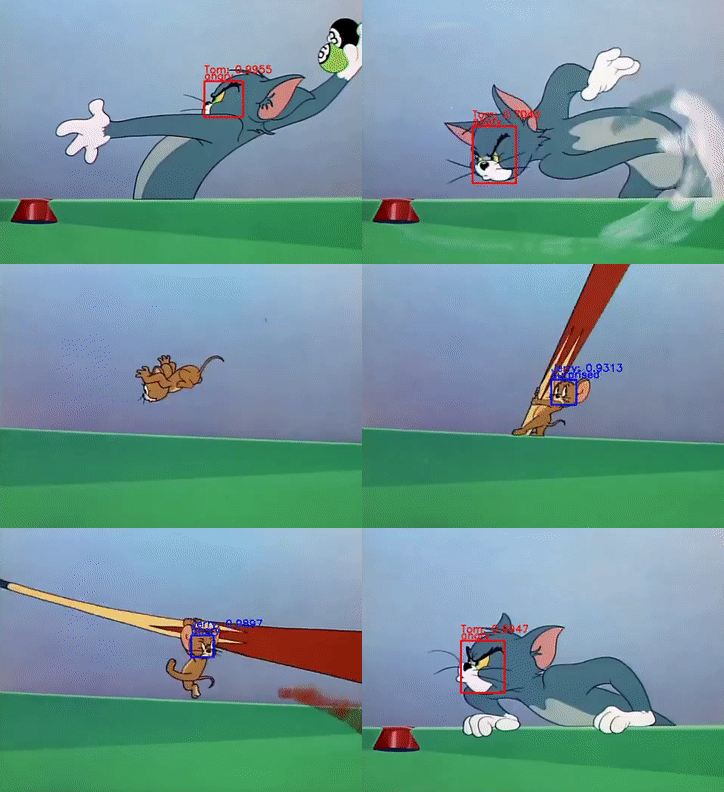
This project marries machine learning with computer vision to create an emotion detection system for "Tom and Jerry" animations. A custom dataset was developed by labeling video frames for emotions like Happy, Angry, Sad, and Surprised using the LabelImg tool. The system employs the YOLO algorithm for object detection and VGG-19 CNN for classifying emotions, achieving a notable 82.9% accuracy in recognizing emotional expressions.

Technical Highlights:

  • Dataset Construction: Leveraged the LabelImg tool for detailed annotation, creating a custom dataset from "Tom and Jerry" video frames.
  • Object Detection: Implemented the YOLO (You Only Look Once) algorithm for pinpointing emotions in real-time.
  • Emotion Classification: Utilized the VGG-19 Convolutional Neural Network for distinguishing complex emotions with high accuracy.

Technologies Used:

Python, OpenCV, YOLO, VGG-19 CNN, LabelImg.

Source

FLAN-T5 Dialogue Summarization gif

Enhanced & Detoxified Dialogue Summarization with FLAN-T5

This project elevates dialogue summarization by utilizing FLAN-T5 for a spectrum of inferences and prompt engineering, bolstered by PEFT fine-tuning and PPO for content detoxification. It delivers summaries with unparalleled accuracy and ethical alignment.

Technical Highlights:

  • Advanced Summarization Techniques: Employed FLAN-T5 with zero, one, and many-shot inferences for versatile learning capabilities.
  • PEFT Fine-Tuning: Conducted precise model tuning with Prompt Engineering with Fine-Tuned templates to optimize summarization performance.
  • Detoxification via PPO: Applied Proximal Policy Optimization to effectively reduce toxic content, ensuring integrity in generated text.

Outcomes:

The initiative resulted in notable improvements in summarization precision, as evidenced by ROUGE metric evaluations, enhancing both accuracy and content quality.

Technologies Used:

FLAN-T5, Proximal Policy Optimization (PPO), ROUGE metrics, Python.

Anime Recommendation System Visualization

Anime Recommendation System

Engineered a robust Anime Recommendation System using PySpark's ALS for collaborative filtering, capable of handling a 7.35GB dataset to refine user personalization and accuracy. The system features a PySpark-driven backend with Flask API integration and a React frontend for an immersive user experience.

Key Features:

  • Scalable Architecture: Efficient data management with PySpark ensures adaptability to large datasets.
  • Personalized Recommendations: ALS matrix factorization fine-tunes user-specific suggestions.
  • Full-Stack Interface: A synergistic backend and frontend development with Flask and React create a seamless platform.

Technologies Used:

PySpark, ALS Matrix Factorization, Flask, React, Collaborative Filtering.

Geospatial Wildfire Risk Prediction Visualization

Geospatial Wildfire Risk Prediction

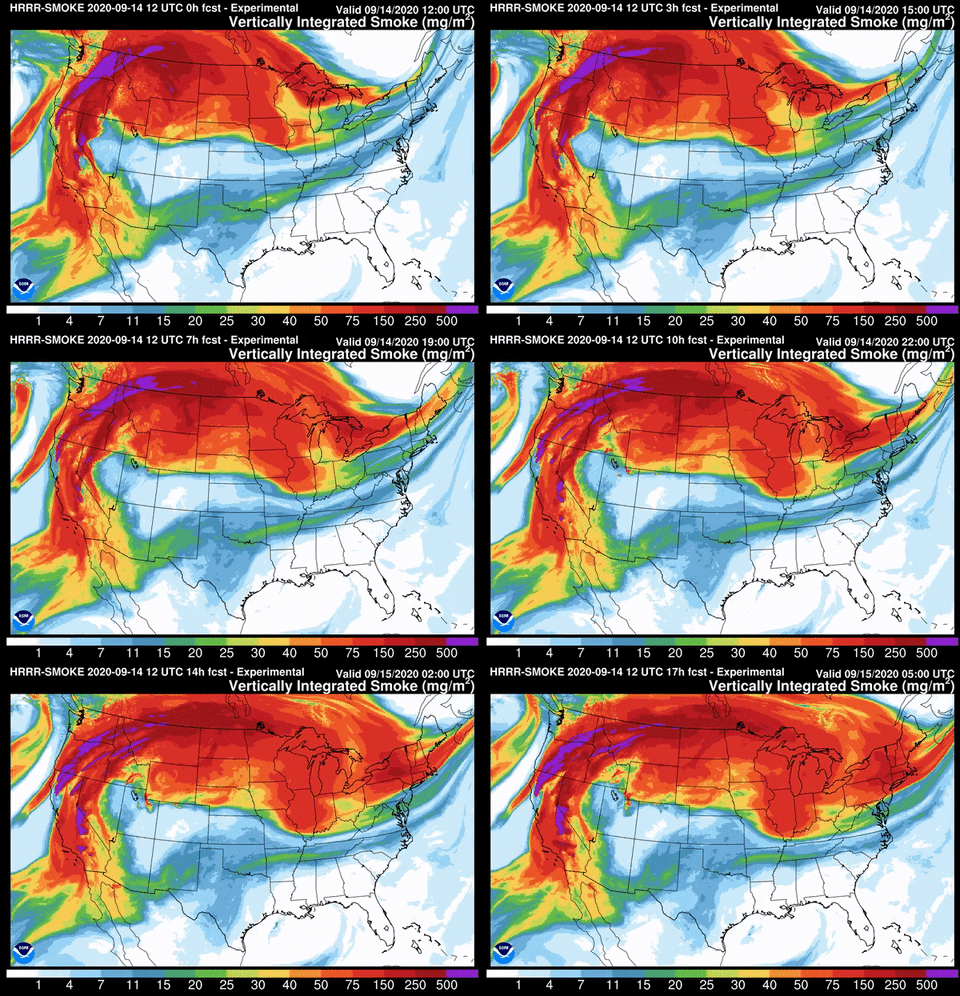
This project pioneers a machine learning system using U-Net to predict wildfires from satellite data with high precision. Analyzing indices like NDVI and LST from MODIS, and integrating with ArcGIS for detailed visualizations, it substantially aids in early detection and disaster readiness.

Highlights:

  • U-Net for Spatial Data: Precision segmentation to assess wildfire risks.
  • Geospatial Data Analysis: Utilized ArcGIS for sophisticated visualization and in-depth analysis of geospatial data related to wildfire risks.
  • Comprehensive Risk Assessment: Integrated various data points (NDVI, LST, thermal anomalies) for a holistic view of potential wildfire hazards.

Technologies Used:

U-Net Model, MODIS Satellite Data, ArcGIS, Python, Machine Learning, Geospatial Analysis.

Certifications

Coursera

Coursera Certifications

  • Generative AI with Large Language Models

    by DeepLearning.AI, Amazon Web Services - View Certificate

  • Introduction to Generative AI

    by Google Cloud - View Certificate

  • Introduction to Data Science in Python

    by University of Michigan - View Certificate

  • Machine Learning Foundations: A Case Study Approach

    by University of Washington - View Certificate

  • Introduction to Software Testing

    by University of Minnesota - View Certificate